
VISION REQUIRES CONTEXT AND PERSPECTIVE TO RESONATE
Approach
Making What’s
Distinct
Visible,
And Valuable
Harnessing
Intergenerational
Expertise
Understanding how cities and culture are shifting is essential to remain competitive and relevant. I help designers contextualize societal shifts: how climate, affordability, equity, and social infrastructure are changing how we live. In parallel, I help creatives interrogate their values and lived experience to position voice. Both require a deep study of culture and character. Both require an artful synthesis to inform a strategic vision.
I work with firms to address all facets related to market positioning: messaging, public profiles, books of business, goal setting, and thought leadership. In tandem, I grow leadership capacity.
Organizational alignment fuels performance and profitability.
Prominence won’t be sustained using the same playbook. We need to be more attuned to how climate, affordability, equity, and social infrastructure are changing design outcomes. And we need to be facile in harnessing intergenerational expertise and perspective if firms are to enjoy lasting influence. Both lenses yield competitive advantage. Both contexts yield influence.
VISION REQUIRES READINESS
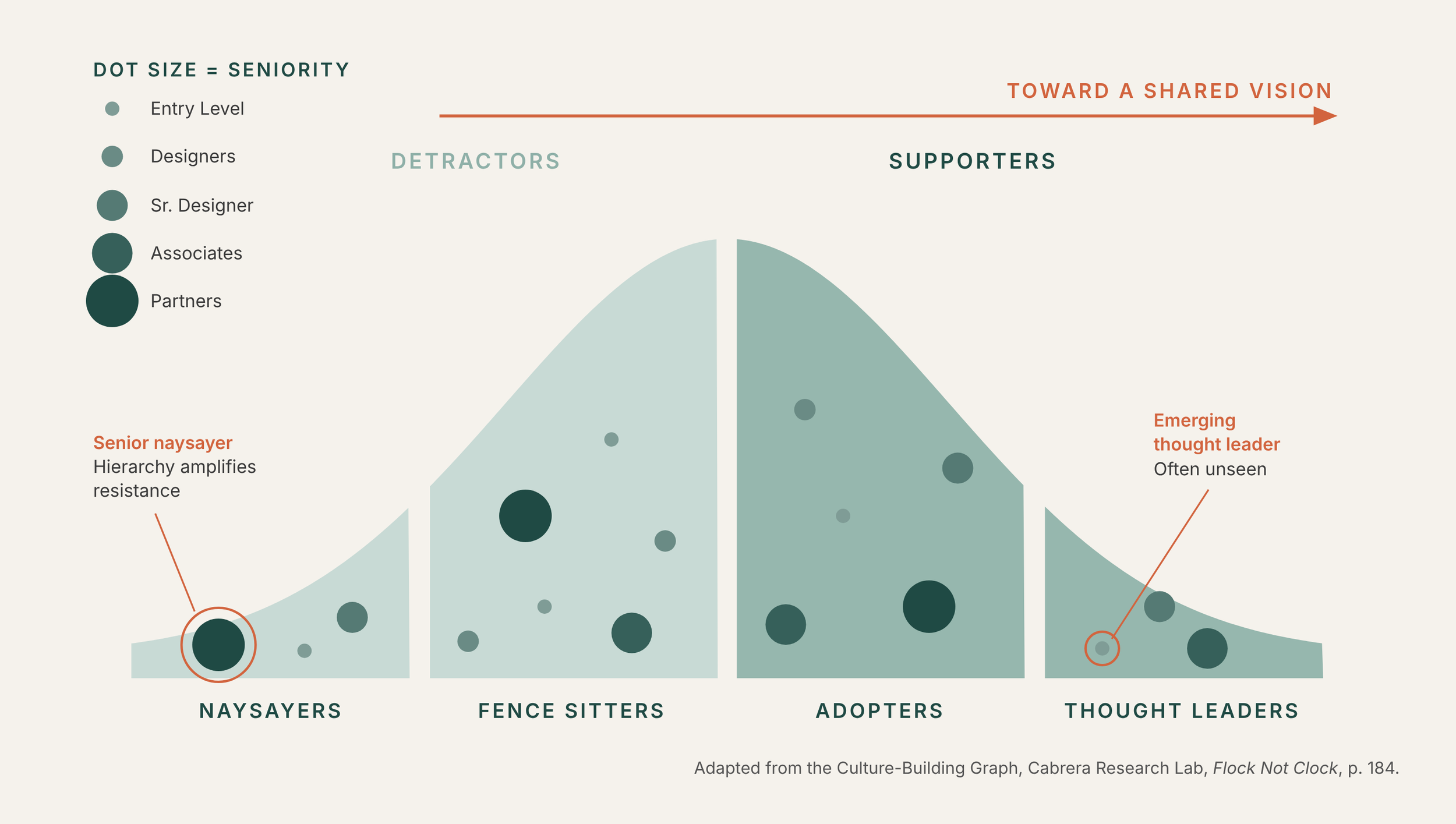
Too often, firms get trapped thinking change comes from the top. Vision does, and should. But cultural change (daily attitudes, behaviors, and work products) is shared. Place your energy in those who willingly embrace change; they create momentum and shift a studio’s culture. Change is realized via attitude and adaptability.
Build Momentum
Change initiates and flows from where there is energy, not only where there is authority.
Skill and Will Are Different
Mastery without buy-in produces capable resisters. Buy-in without mastery produces enthusiasts who can't yet deliver. Firms need both skillful and willing employees to deliver change.
The Power of Modeling
Modeling moves a firm forward faster, and it scales. It's also the most efficient way to introduce designers to the business side of practice: client relations, strategic decision-making, and storytelling.
Vision Agents Hide in Plain Sight
Rank doesn't make a cultural leader. Willingness and buy-in do. Look across your firm, not your org chart, to find them.
INFLUENCE REQUIRES MASTERY
Too often. firms look to their leadership teams to drive innovation while missing who has the capacity and aptitude to lead change. It's a missed opportunity.
WORKING ACROSS THE STUDIO
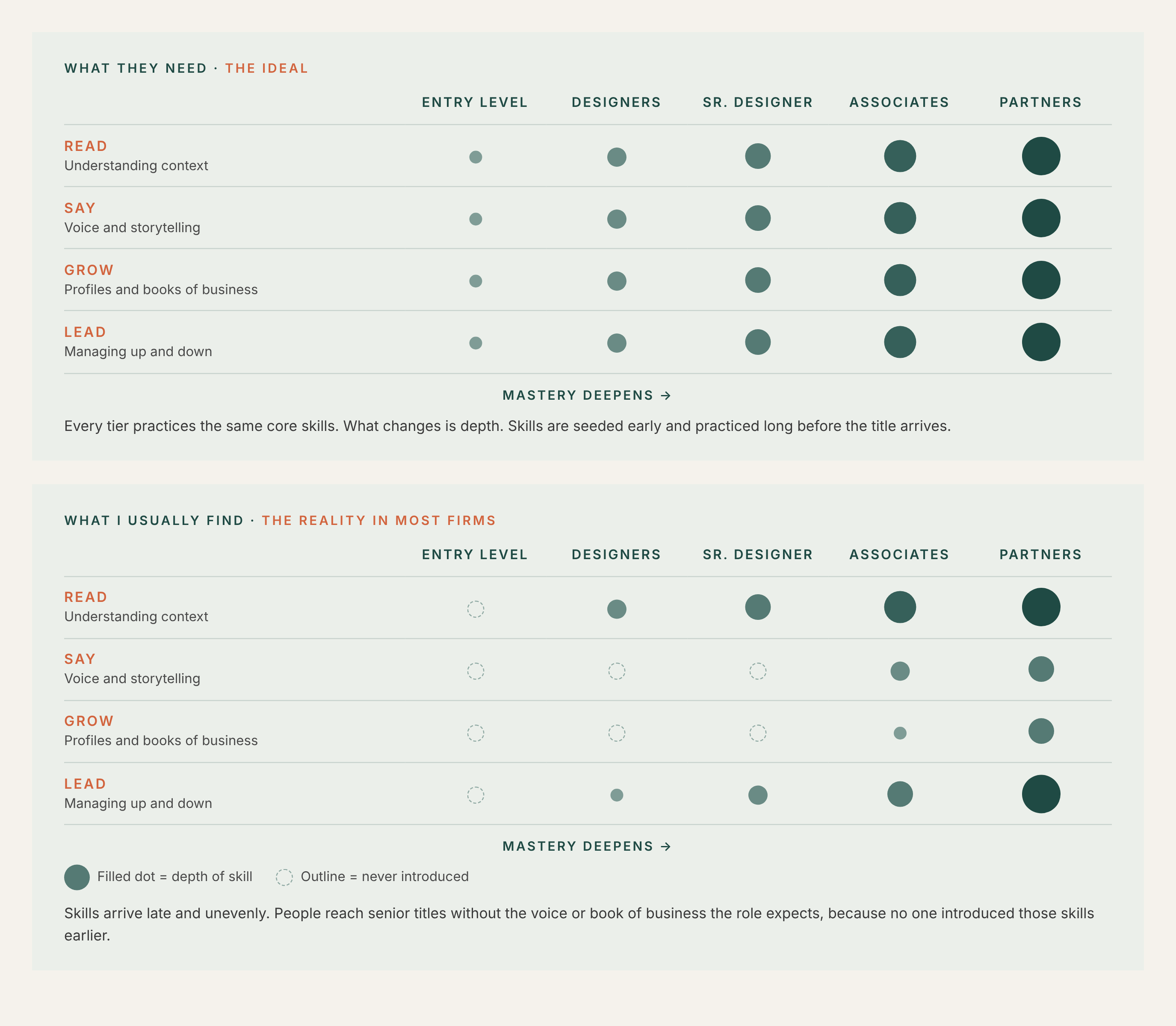
Skills take time to develop. Introducing them early and explicitly, and showing how they apply across multiple instances, helps designers master them. Too often, staff are expected to be proficient (if not fluent) in skill sets they have never been introduced to, modeled, or discussed. That is why I wish to work across all tiers, growing capabilities, capacity, and design voice so everyone can meet the moment.
Example
CONTEXTUAL UNDERSTANDING
EXECUTIVE TEAM
Where is the company the most vulnerable? How are markets shifting? What is the health of your pipeline, and what actions need to be taken, and by when?
PRINCIPAL AND SENIOR LEADERS
I am often asked to coach BD for newly made principals. When I ask for their personal views on key topics in their city or desired territory, they don’t have their own opinion. They hesitate. Traditionally, they would relay the founder's or executive group's point of view. I help them articulate their own take on positions, brand-sympathetic but of them.
MID-SENIOR LEADERS
I am asked to help them build their personal networks. Again, voice and market understanding are important. Their thought leadership doesn’t have to be as focused as the executive group, but they do need to look for trends and understand the current state of the marketplace (if not begin to have ideas of where it’s going). I introduce pattern recognition and trend analysis as we build BD plans and begin to grow their public profile. I help them strategize pursuits and talking points, some specific to the brief, much more around the project context and considerations.
JUNIOR STAFF
Given they are the ones visualizing the diagrams, I begin introducing contextual analysis. What are we looking for the diagrams to say and why? When you help junior staff understand the mission, they often come back with new and perhaps more insightful information.
Transmission Journal
-
![]()
Monet Goode
Senior Strategy Analyst
-
![]()
Emmett Marsh
Operations Consultant
-
![]()
Eleanor Parks
Financial Modeler
-
![]()
Karl Holland
Change Management Lead
-
![]()
Jaya Dixon
Digital Transformation Specialist