Re-enchanting the Champs-Élysées
Interplay Volume 3
RELM’s Social Media Team + Valorie Born
Courtesy of RELM
The Paris Olympics were a visual feast, with France’s national treasures serving as an iconic backdrop for athletic competition. How does this capital city continue to lead 21st-century urbanism, and what lessons can LA adopt ahead of the 2028 Olympiad?
EDITOR’S LETTER
Watching Paris celebrate pageantry, athleticism, and French heritage has been spectacular. These Olympic games—touted as the greenest and most equitable—exude high design and pride of place. Spectating has been a visual feast, both in terms of competition and seeing France’s national treasures serve as a backdrop to athletic sport.
It’s undeniable that the Games present a capital city at the forefront of 21st-century urbanism. Mayor Anne Hidalgo has transformed the city center, kicking out cars for bikes and pedestrians, has reclaimed the Seine as an urban swimming pool, and is working on addressing housing affordability. There has been a visible transformation in the quality of their public realm since they were awarded the Olympic bid. It’s difficult to imagine how Los Angeles will match, and ideally surpass, the creativity and beauty of the Paris Games. How exactly did they seize this moment so brilliantly? The answer (in part) begins well before Hidalgo took office, when former French President Nicolas Sarkozy captured the collective imagination, seeding a new idea of ‘Greater Paris’ in 2007. He initiated the remaking of a modern Paris.
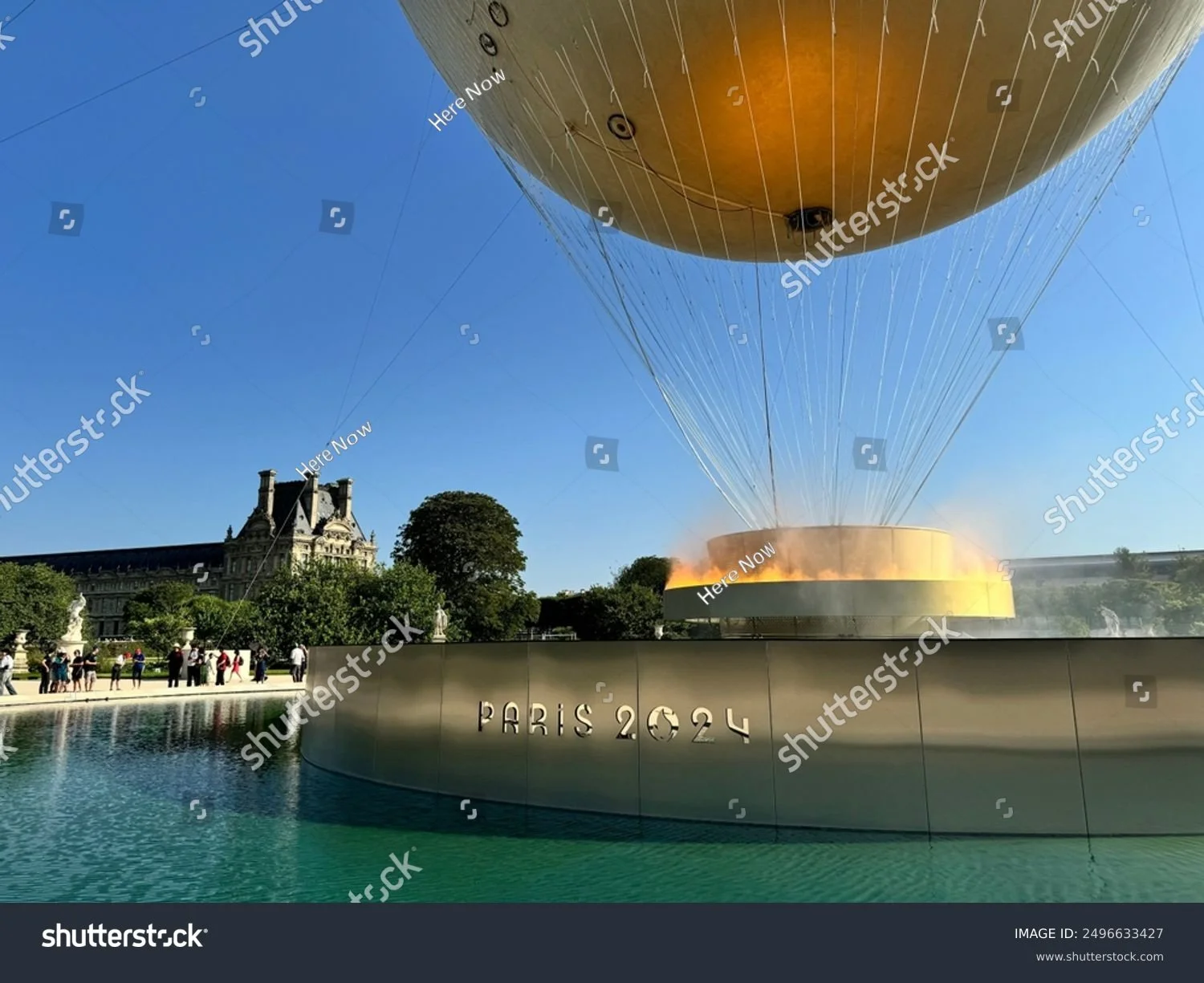
“These will be French-style Olympics using our unique heritage to reinvent the Games. It will not only show who we are but also what we are capable of.” — Paris Olympic Committee Spokesperson
The Metropolitan Project
Since Mayor Hidalgo took office in 2014, Paris has experienced a 40% drop in air pollution and has created over 1300 Kilometers of dedicated bike lanes. Her version of urban life—walkable, treelined, and neighborhood-scaled—is imprinted throughout the city center. As much as her record speaks for itself, Hidalgo owes much of her success (at least the willingness of the French people to contend with the inconveniences of urban transformation) to the effort and legacy of former French President Nicolas Sarkozy. In 2007, he announced his ambition to knit together Paris’ city center and suburbs for the first time to create a larger Parisian metropolis. Sarkozy recognized that the suburbs (its people, institutions, and commerce) were the critical mass he needed to expand Paris’ influence and that the geographies needed to be connected through public transit. His plan was called ‘Greater Paris.’ He invited 10 architectural-led teams to envision how station design could render an entirely different city and what that might mean to communities. The responses captured the imagination of the Parisian public. Through these investigations, his mobility plan, ‘Greater Paris, ‘gave way to the construct of ‘Grand Paris,’ an open-ended dialogue about how citizens want to live in their city.
In 2014, Sarkozy’s transit plan coalesced into a state-of-the-art vision for connecting the banlieues (the suburbs) to the urban core. The Grand Paris Express was announced. 68 new stations, supported by 200 kilometers of new underground tunnels, will realize Grand Paris. It will deliver Sarkozy’s metropolis, go on to support Hidalgo’s climate targets and help achieve another initiative: that of the 15-minute city, as most of these new stations are expected to bring density and new programming to a large geography. As Simon Kuper of the Financial Times (12 July 2024)1 states:
The transit project for Grand Paris has nothing to do with the Olympics, except that the Games set a deadline for delivering phase one.... In the next few years, Grand Paris could bring an even bigger urban transformation than the one wrought by Baron Haussmann from the 1850s.
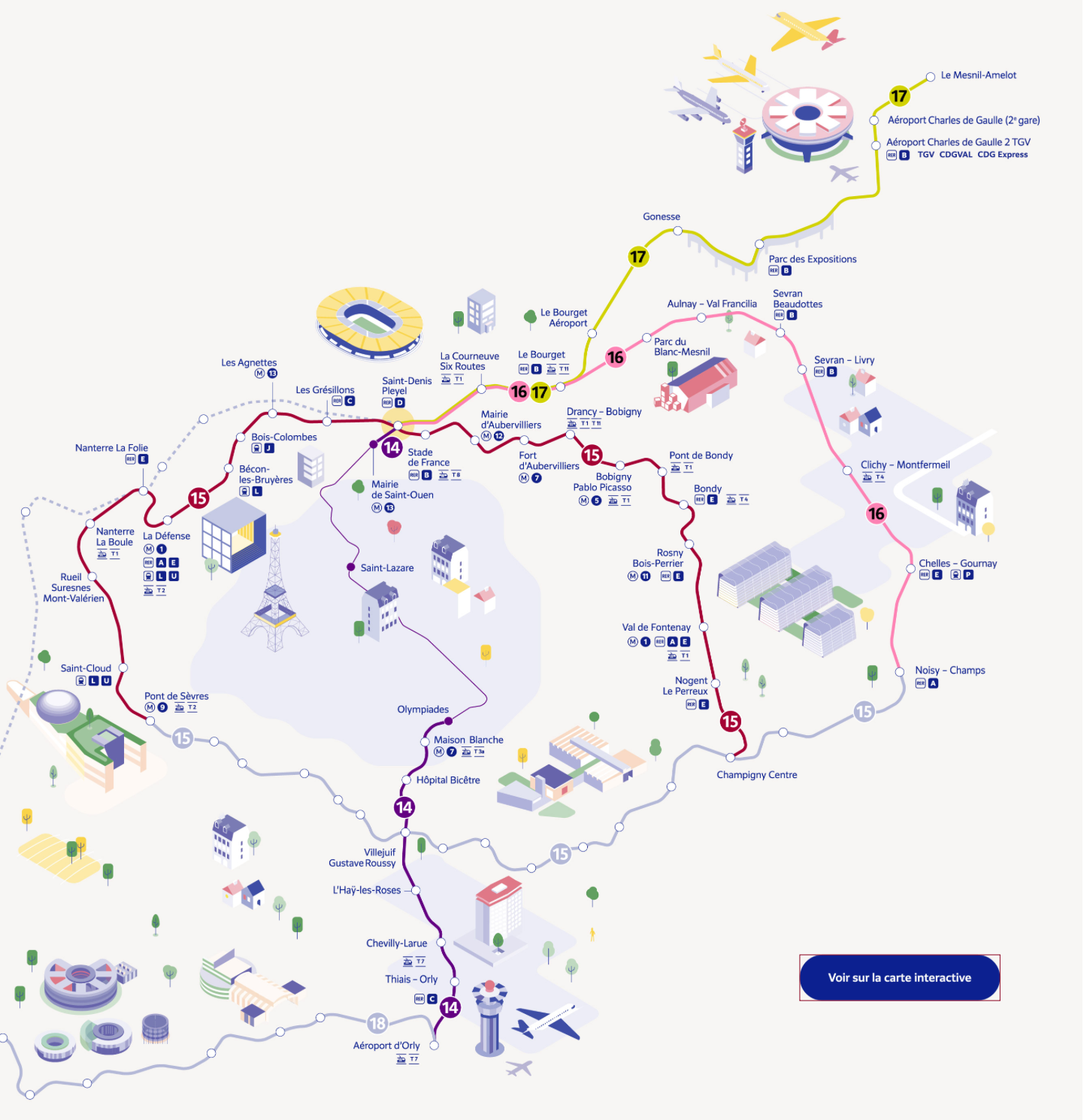
Map of Grand Paris Express.
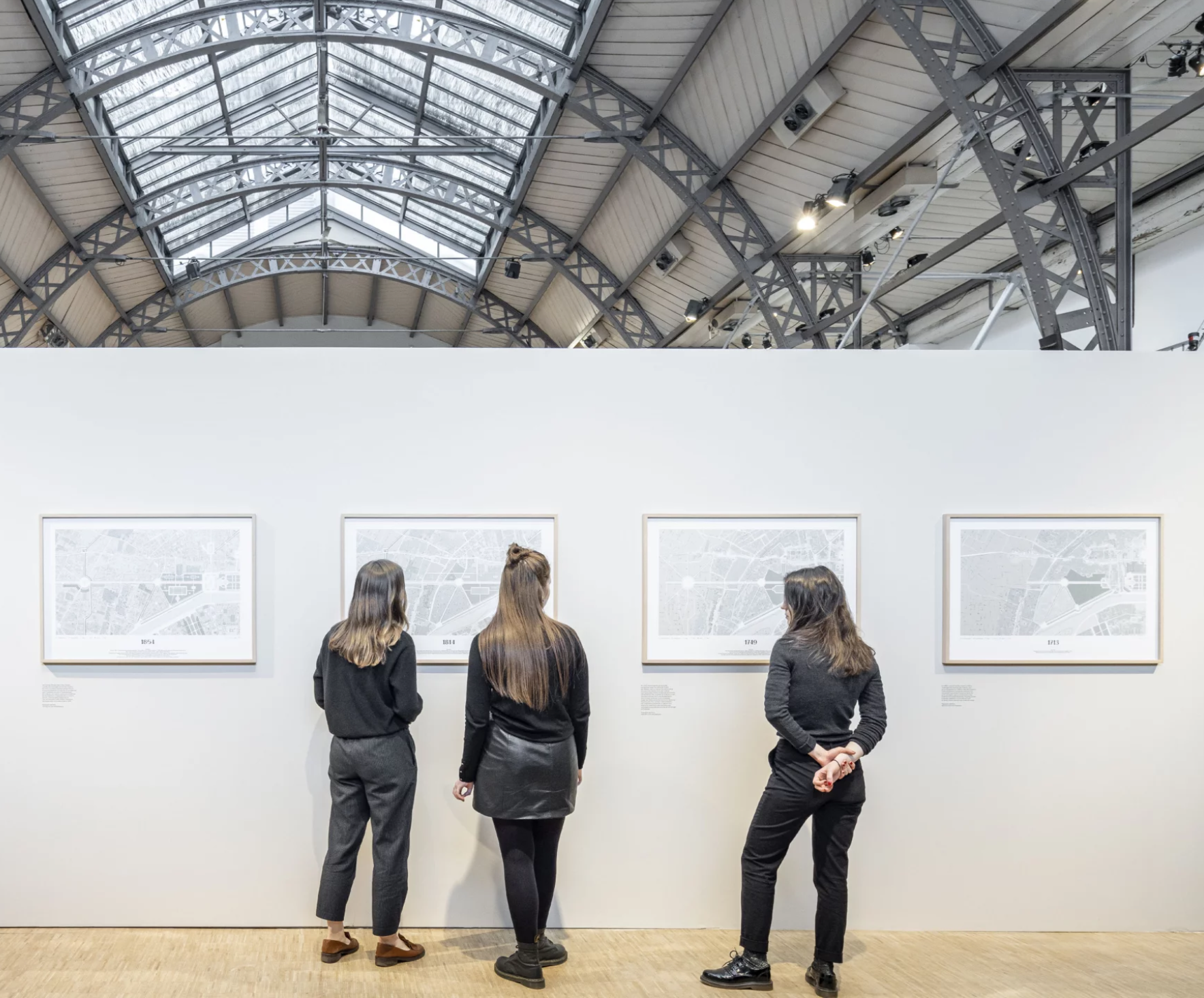
Re-Enchanting the Champs-Élysées Exhibition - PAVILLON DE L’ARSENAL. Image by PCA-STREAM.
Sparking Collective Imagination
Understanding the arc of Paris’ modern urban transformation prompted us to revisit RELM’s inaugural Interplay article, Verdant Pleasure, chronicling the inventions that gave rise to the iconic metropolis. In this, we showcase advancements Paris made starting after the Wars of Religion to transform the City of Light from ‘ruin to wonder,’ and how Los Angeles could benefit from applying some of the same ideas. In her book, How Paris Became Paris, author/historian Joan DeJean, Trustee Professor at the University of Pennsylvania, meticulously documents how public works projects recast the French capital
Her research asserts that sidewalks along the Pont Neuf and the Place Royal, the first purpose-built public recreation space, were the first two seminal inventions that gave birth to the City of Light. From there, Louis XIV envisioned grand tree-lined boulevards and commissioned the Tuileries. By 1700, Paris became the grandest walking city in all of Europe. She argues that civic vision, civic leadership, appointing the design community to craft and execute a vision, and, importantly, inviting the public to experience the benefits of public works created a brand and pride of place.
Paris benefited from what would now be called a rebranding campaign. A continuous stream of publications and images....helped produce a new kind of city. They made Parisians proud and thereby created a sense of community. They also taught people how to use revolutionary public works and services—how to mingle in public gardens, how to take advantage of street lighting and public transportation to negotiate an expanding urban footprint.2
Be it the Paris of the 1600s or 2024, Los Angeles can take note of how France has made city-building a local and global enterprise. Yes, we are not French. We don’t benefit from centuries of state planning. But we can move mountains (think Sepulveda Pass Metro line), move water (become water-independent by 2035), and move cars off the roadways (reduce greenhouse gas emissions). There was so much civic momentum ahead of COVID: The Lucas Museum of Narrative Arts, The Tar Pit Master Plan, Measure M. These are enormous undertakings. Thankfully, all are still happening, but each has been delayed or altered. Many projects will open ahead of the 2028 Games, but their project timeline has deflated the emotional understanding of these endeavors. Take the Lucas Museum, for instance. Construction broke ground in 2018 and it’s scheduled to open in 2026. Pershing Square held an international design competition in 2015. It was awarded to Agence Ter and Salt Landscape Architects and immediately went on pause. The design had to be altered from a concept of ‘radical flatness’ to ‘radical openness.’ The site is currently fenced, under construction since late 2023, and only Phase 1 (A and B) will be ready for the Olympics. Even for those of us who work in the A/E industry, such timelines are punishingly long.
Beyond time, however, we need to focus on how we want to leverage these assets for community vitality. How do Angelenos want their communities to respond to climate change, hybrid work patterns, and racial justice? These conversations are not suited for City Hall alone—they never were.
Paris has sustained public engagement through exhibitions, expert studies, and public realm takeovers. From 2007 to now, to the foreseeable future, city-making is a collective undertaking. Re-Enchanting the Champs-Élysées is a superb example. The study, commissioned by The Comité Champs-Élysées and exhibited at the Pavillon de l’Arsenal, looks at how to invite Parisians back to the boulevard and spur community development of its spine—to create a series of neighborhoods—the Faire Quarter. Their approach is data-driven, aspirational, and experiential alike. Jean-Noël Reinhardt, President of the Comité Champs-Élysées, opens his Exhibition forward reiterating why public process is essential:
This exhibition is an invitation to the public of Paris to participate in the envisioned reinvention of an iconic avenue and neighborhood. Everything about our process is based on collaboration, engagement and experimentation, which we consider integral to the success of this project.
PCA Stream’s Re-envisioning of Champs-Élysées
In 2018, the Champs-Élysées Committee—an association of major public and private stakeholders along the avenue—commissioned PCA-STREAM to develop a study titled Re-enchanting the Champs-Élysées, which was presented at a symposium in April 2019. The agency continued this exploration with the study Champs-Élysées, History & Perspectives, broadening the discussion of the Champs-Élysées to the future of urban areas—a project that led to an exhibition at the Pavillon de l’Arsenal in February 2020. As a counterpoint to a historical narrative, the aim is to conduct an analysis and outline perspectives to connect the local context of the Champs-Élysées with the challenges of contemporary urban globality. PCA-STREAM is undertaking this groundbreaking urban research with a multidisciplinary team of experts, including researchers from renowned academic institutions (MIT, Harvard, Sciences Po, etc.) as well as creators, in line with its approach that blends art and science.
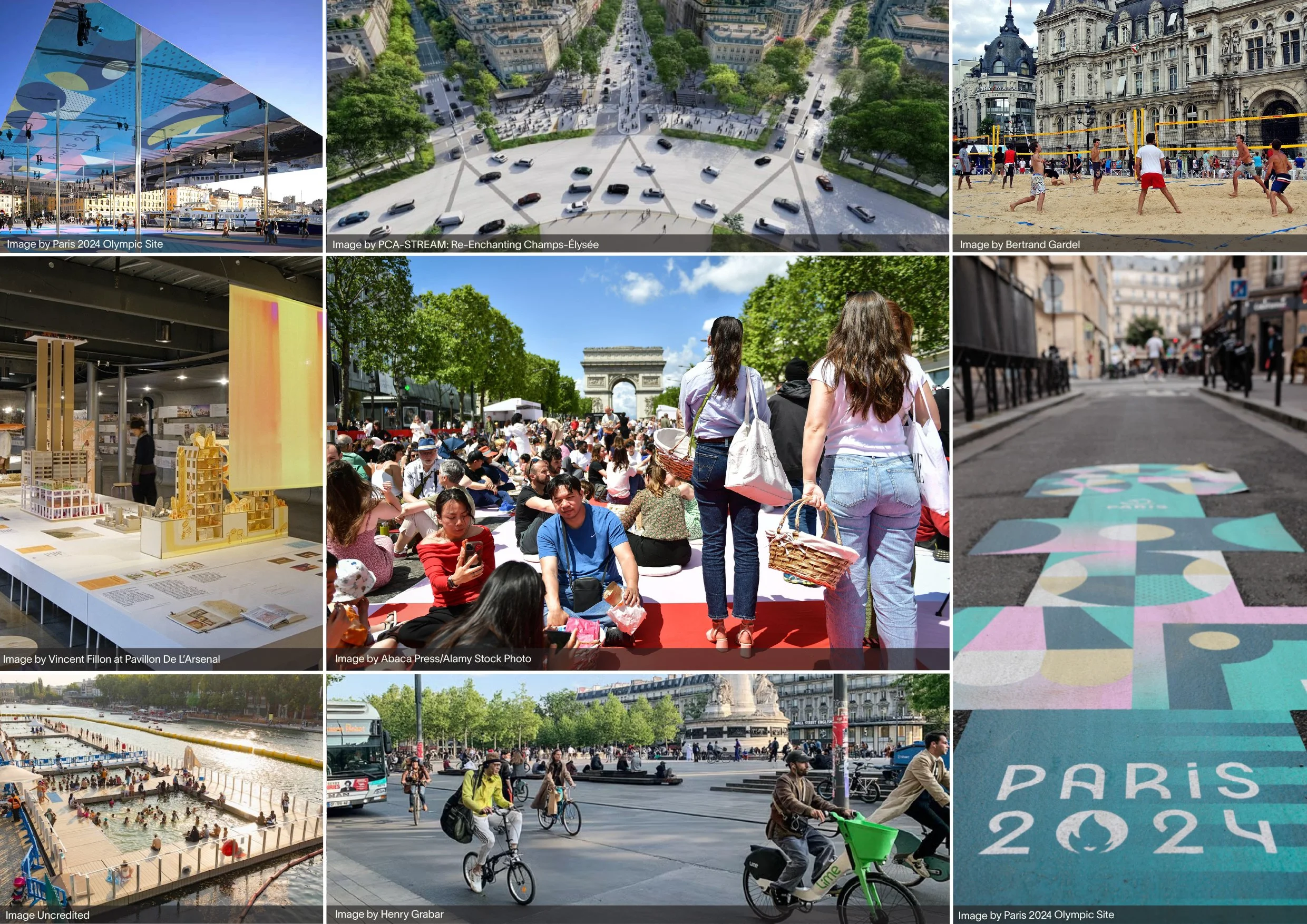
In addition to the Champs study, Paris has infused folly into the city. Annually, they celebrate summer with temporary beach-themed events around the city, from beach volleyball to a faux beach along the Seine. They have personalized the experience of reclaiming the public realm for more dedicated use.
All of these efforts, in addition to the Metro expansion and policies enacted by a visionary Mayor, have rendered the Parisian capital with splendor. Civic leaders understand the timelines involved in city-making, but they sustain public goodwill and interest through dialogue and fanfare. Ciclavia is one such event that Los Angeles does well in creating civic interest. What else can we do? And importantly, as Lucas, LACMA, the Convention Center, and other civic assets come online, how do we talk about them in connection to their neighborhoods? LA needs its own Metropolitan Experiment. What would our version of Paris look like? We are polycentric. RELM knows this can be a strength.
Let’s not lose the promise of 2028 as our own marker. We have a moment—a city—to envision and inhabit. The Getty’s Pacific Standard Time series could re-awaken LA’s collective consciousness. Their fourth installment, Pacific Standard Time: Art x Science x LA in 2024 opens in September across several sister institutions. Many of us recall their 2013 exhibition on Modern Architecture in Los Angeles. We need civic programming that is distributed across LA’s many geographies to crowd source needs and aspirations, inviting a citizenry to dream, adapt, and thrive together coupled with tenants we proposed in RELM’s first Interplay issue: codifying public realm best practices, designating landscape as critical infrastructure, and empowering civic champions. All three principles are evident in Paris as a case study of verdant modernity and why LA lacks a consistent and quality public realm. We have four years before our city is on the world stage. Let’s inspire Angelenos and the world over what our imagination can render.
CITATIONS
WORKS CITED
Kuper, Simon, “Paris, the Olympics and the reinvention of a city,” The Financial Times, 7/12/24.
DeJean, Joan, How Paris Become Paris, Bloomsbury USA; 2015, p 5.
Reinhardt, Jean-Noël, “The Parisians’ Project,” Champs Élysées: History and
Perspectives Exhibition Catalog at Pavillon De L’Arsenal, 2020.
GRAND PARIS REFERENCES
https://www.grandparisexpress.fr/benefit-metro-ile-de-france
https://www.societedesgrandsprojets.fr
CHAMPS ÉLYSÉES + PARIS 2050 REFERENCES
https://www.pavillon-arsenal.com/en/expositions/11463-champs-elysees
https://www.pavillon-arsenal.com/en/expositions/12918-moving-towards-paris-2050
https://www.pca-stream.com/en/projects/the-champs-elysees-history-perspectives-study
https://www.media.mit.edu/projects/city-scope-champs-elysees/overview